Activity: Poem-Inspired Art
For National Poetry Month, we’re exploring the many emotions poems can make us feel and the many ways they can help us understand the world. Poetry can be read alone, read aloud to others, set to music, or used to inspire art! One way to enjoy poetry is to create art inspired by the feelings and ideas it evokes. This is an excellent way to process and share the feelings that come up when reading or hearing poetry. Here’s how to do it:
Step 1: Pick a Poem
You can use any poem you’d like, but here are a few ideas to get you started:
- “The Tyger” – by William Blake
- “Mother to Son” – Langston Hughes
- “Hope is the thing with feathers” – Emily Dickinson
- “A Boat Beneath a Sunny Sky” by Lewis Carroll
You could also listen to a favorite song instead – song lyrics are also a kind of poetry! I’ve chosen to work with “Wild Geese” by Mary Oliver.
Step 2: Look for Images, Adjectives, and Colors
What colors does this poem feel like? Is it a thoughtful sky blue? A hopeful yellow? An energizing green? An angry red?
What shapes does this poem bring to mind? Maybe it’s a round collection of circles and ovals, or maybe it’s angular stars and triangles.
What textures does this poem remind you of? Is this poem smooth, sharp, coarse, fluid, fluffy, or scratchy?
To me, “Wild Geese” feels like sky blue and forest green, with muted greys and browns mixed in and a little glimmer of golden sunlight. I picture free swirls of color and asymmetrical round shapes, like pebbles. I feel the textures of downy feathers and pine needles, and the smooth stone of a riverbed pebble.
Step 3: Pick your Materials
What materials and media feel right? Crayon, colored pencil, markers, or paint? Could you add texture on top of it, like tinfoil, tissue paper, leaves, stickers, or tape? What about creating a collage with photos, stickers, and other scrap pieces? What if it’s a sculpture made from clay, pipe cleaners, cardboard, or toothpicks? The possibilities are endless!
I feel inspired to use watercolors and pens. If I could find feathers, they might make a strong addition. I would also love to incorporate some scrapbooking elements!
Step 4: Get Creating!
Set up your space with your paper and other materials. Then, using the shapes, textures, and colors that you brainstormed earlier, start working on your art! Listen to ICAN Radio while doing this activity for an extra burst of creative inspiration. Here’s a step-by-step of how I made my piece:
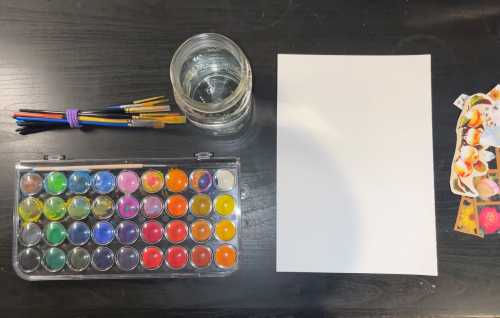
1. Gather materials
I found thick paper that can hold the paint, some watercolors, brushes, clean water, pens, glue, and scraps I felt inspired to incorporate. I also taped down my paper to keep it still while I work. This will help to give a clean, defined edge to the paint.
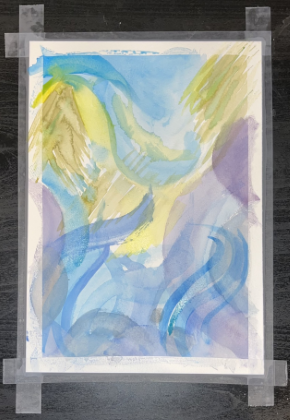
2. Watercolor
This is mostly where I’m incorporating the colors I brainstormed earlier. I painted swirls of blue and strokes of green, then shaded them with brown tones to give them some depth.
3. Collaging & Finishing Touches
I picked a scrap piece (the apples) that really spoke to me and glued it down once the paint dried. Finally, I went in with a black pen and added inked details where I wanted the piece to pop.
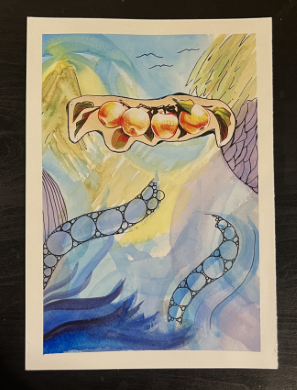
This is my final piece!
If you’d like to share your art on social media, tag us @ican.radio. We’d love to see your work!